Whether your culinary goal is a sweet, decadent crepe nutella configuration for dinner or a hearty, protein-packed plate of savory crepes for brunch, mastering the classic french crepes template is a foundational kitchen skill. Elegant, delicate, and paper-thin, a proper crepe acts as a versatile canvas for an endless array of sweet fruits, rich chocolates, or earthy cheeses.
Many home cooks shy away from making crepes from scratch, assuming the process requires specialized skills or expensive culinary hardware. In reality, whipping up a batch of homemade crepes is incredibly simple once you understand how to manage the structure of your batter.
This comprehensive guide covers the science of flour hydration, a foolproof easy crepes recipe, a detailed nutritional assessment, and an essential troubleshooting FAQ section.
The Physics of Fluidity: Why Crepe Batter Needs to Rest
At its core, a simple crepe is an ultra-thin cousin of the traditional pancake. However, while regular pancakes rely on chemical leaveners like baking powder to create thick, airy pockets, crepes require a completely flat, flexible, and tender structure.
To achieve this texture, you must manage two structural components: gluten development and air dissipation. When you whisk flour into a liquid matrix of milk and eggs, you automatically cross-link the proteins gliadin and glutenin, creating an elastic gluten network.
If you pour this freshly mixed batter straight into a hot pan, that tight gluten network will cause the batter to shrink, snap back, and cook into a tough, rubbery texture.
By allowing your basic crepe batter to rest in the refrigerator for at least 30 minutes before cooking, you unlock a vital biochemical reset:
-
The over-activated gluten strands completely relax, ensuring the cooked crepe remains tender and easy to cut with a fork.
-
The flour granules fully absorb the liquid, creating a velvety, uniform viscosity.
-
Any air bubbles whipped in during mixing escape, preventing holes from forming as the thin batter hits the hot pan.
Required Equipment and Ingredient Parameters
To turn out the best crepe stacks without tearing, your pan selection and heat control must be precise.
Essential Equipment
-
A 10-Inch Non-Stick Skillet or Cast Iron Crepe Pan: Low, sloping sides are essential, allowing a spatula to slide underneath the delicate edges effortlessly.
-
A Small Wire Whisk or Blender: Blending your ingredients ensures a smooth batter devoid of tiny flour pockets.
-
A Non-Stick Silicone or Off-Set Spatula: A long, thin blade lets you lift and flip the crepe cleanly.
Ingredient Quality Guidelines
The Flour: Standard all-purpose flour provides the perfect balance of proteins. For traditional rustic savory crepes, swap half the white flour for earthier buckwheat crepe flour.
The Liquid Matrix: Whole milk introduces essential dairy fats that keep the cooked batter pliable.
The Fat: Melted unsalted butter added directly into the liquid batter adds a rich flavor and acts as an internal lubricant, preventing the crepe from welding itself to your skillet.
Step-by-Step Easy Homemade Crepes Recipe
Follow this optimized technique to create a beautiful stack of light, golden breakfast crepes in your standard home kitchen.
Ingredients
-
1 Cup All-Purpose Flour
-
2 Large Eggs
-
1.25 Cups Whole Milk
-
2 Tablespoons Unsalted Butter: Melted and slightly cooled.
-
1 Tablespoon Granulated Sugar (Omit if making strictly crepes savoury versions)
-
1/4 Teaspoon Fine Sea Salt
-
1 Teaspoon Pure Vanilla Extract (Optional, for crepe dessert variations)
Step-by-Step Instructions:
Crack your eggs into a large blender pitcher or deep mixing bowl. Add your whole milk, melted butter, sugar, sea salt, vanilla extract, and all-purpose flour.
Blend on high speed for exactly 20 to 30 seconds until the mixture is completely uniform and resembles the consistency of heavy heavy whipping cream. If mixing by hand, whisk the liquids thoroughly first, then slowly sift in the flour to avoid lumps.
The Critical Rest: Place the covered batter into your refrigerator for a minimum of 30 minutes (or overnight).
Place your 10-inch non-stick skillet over medium heat. Brush the pan surface lightly with a tiny dab of melted butter. You only need a micro-layer of fat; a greasy pan will cause the batter to slide around rather than cling and cook.
Lift the hot skillet completely off the stove burner. Pour exactly 1/4 cup of the chilled batter directly into the center of the tilted pan.
Immediately rotate your wrist in a swift, circular motion to swirl the batter across the entire base of the skillet, creating an even, ultra-thin circle. Return the pan to the heat source.
Cook undisturbed for 90 to 120 seconds. You will know it is ready to flip when the surface looks completely matte and dry, and the outer edges turn golden-brown and begin to curl away from the pan walls.
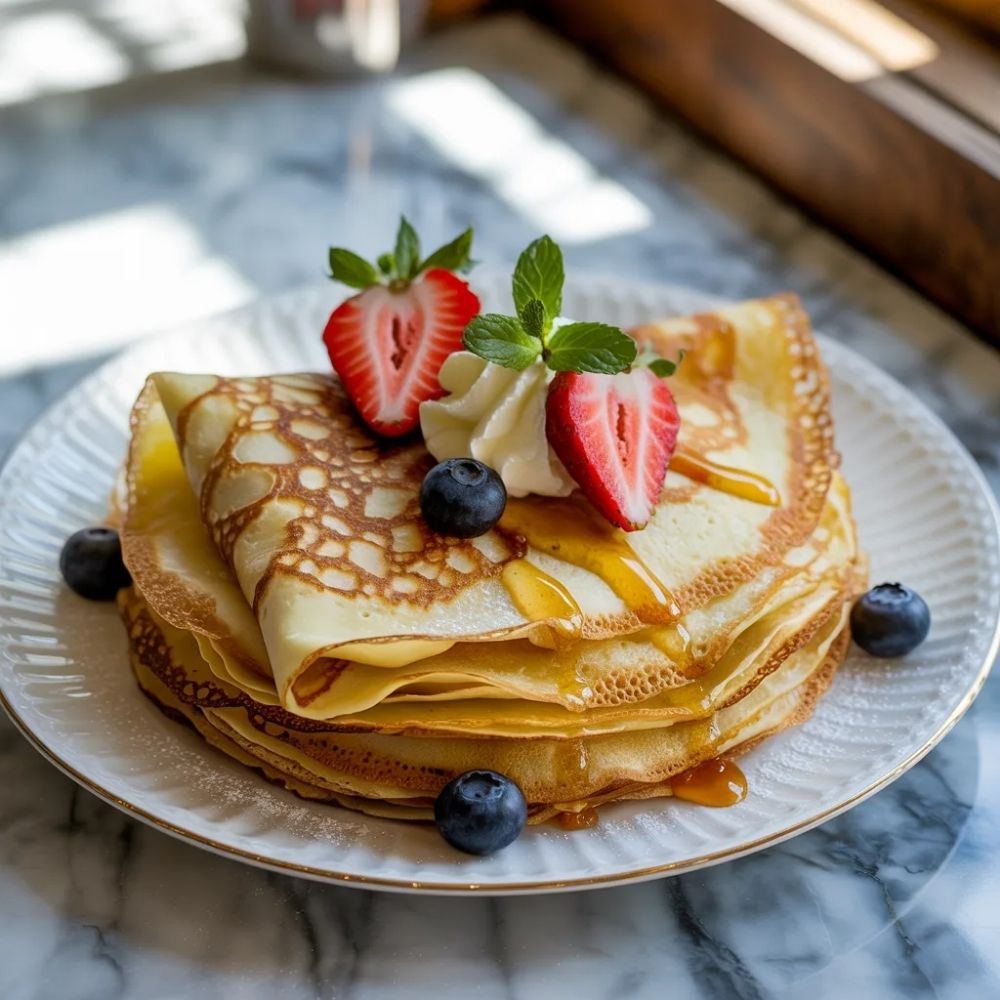
Slide your thin spatula underneath the center of the crepe, lift it gently, and flip it over in one smooth motion. Cook the secondary side for a brief 30 to 45 seconds (this side will feature a beautiful, spotted “leopard” pattern). Slide the cooked crepe pancake onto a warm plate and repeat the process with the remaining batter.
Sweet and Savory Presentation Styles
The beauty of a basic crepe lies in its ability to split into completely different culinary styles based on your choice of filled crepes ingredients.
Sweet Icon: Crepe Suzette
To execute a luxury crepe suzette, prepare a fast stovetop pan-sauce by melting butter with fresh orange juice, orange zest, and caramelized sugar. Fold your cooked sweet crepes into quarters, submerge them in the bubbling citrus sauce, pour a splash of Grand Marnier liqueur over the top, and carefully light it with a match to flambé the dessert tableside.
Savory Classic: The French Galette
To lean into a traditional crepes savoury presentation, utilize a buckwheat crepe base. While the second side of your crepe is finishing in the pan, drop a slice of black forest ham, a handful of shredded Gruyère cheese, and a fresh egg yolk directly onto the center. Fold the four outer edges inward to create a square frame around the egg yolk, allowing the heat of the pan to melt the cheese completely before serving.
Nutritional Breakdown
A single plain, un-filled homemade crepes round cooked using this traditional recipe provides a balanced supply of clean proteins, energy-yielding carbohydrates, and low sodium.
-
Total Energy Output: 90 Calories (kcal)
-
Total Carbohydrates: 10 grams
-
Dietary Fiber: 0.3 grams
-
Sugars: 1.5 grams
-
-
Protein Content: 3.5 grams (derived naturally from the fresh egg and milk proteins)
-
Total Lipid Fat: 4 grams
-
Saturated Fat: 2.2 grams
-
Monounsaturated Fat: 1.2 grams
-
-
Sodium Matrix: 65 mg (highly controlled baseline minerals)
-
Key Micronutrients: Moderate levels of Calcium, Vitamin A, Phosphorus, and Folate.
Frequently Asked Questions (FAQ)
Why is my very first crepe always a torn, rubbery mess?
There is a famous saying in professional kitchens: “The first crepe belongs to the pan.” The initial crepe usually fails because the pan hasn’t reached an even, stable temperature, or there is too much loose butter pooling on the cooking surface.
Consider your first crepe a sacrificial test to calibrate your stove’s heat. Wipe the pan completely clean with a dry paper towel after the first attempt, drop your flame down slightly, and your second crepe will turn out perfectly smooth.
Can I use a pre-packaged commercial mix like Bisquick crepes?
Yes, you can easily use a basic baking mix to speed up your morning routine. To make bisquick crepes, whisk 1 cup of the baking mix with 1 cup of whole milk and 2 whole eggs. Because commercial baking mix flours are pre-sifted and modified, this blend creates an incredibly fast mix crepe variation that doesn’t strictly require the standard 30-minute refrigerator rest window to stay tender.
My crepe batter is riddled with tiny flour lumps. How do I fix it?
If you whisked your batter by hand and notice tiny stubborn pockets of dry flour floating around, do not pour it into your hot skillet. Those lumps will burst into dry, powdery pockets when cooked.
Simply pour your raw batter through a fine-mesh strainer into a clean bowl, using a spoon to press the liquid through while trapping the lumps. Alternatively, pour the lumpy mixture directly into a high-speed blender pitcher and pulse on high for 15 seconds to liquefy the stray flour instantly.
What is the best way to store a large stack of leftover crepes?
Allow your cooked crepes to cool down completely to room temperature on a wire cooling rack. To prevent them from sticking together into a solid block, stack them on top of one another with a small square of parchment paper or wax paper layered between each disc. Wrap the entire stack securely in plastic wrap and store them in your refrigerator for up to 3 days, or place the bundle inside a zip-top bag in your freezer for up to 2 months.
How do I reheat cold crepes without making them stiff and dry?
Reheating crepes in a microwave can quickly turn the delicate edges rubbery and dry. To reheat them properly, place a non-stick skillet over medium-low heat on your stovetop. Drop a single cold crepe into the dry pan for exactly 20 to 30 seconds per side. The gentle heat will rapidly liquefy the internal butter fats, instantly restoring a soft, pliable, and freshly cooked texture.
Crepes
Print ThisIngredients
- 1 Cup All-Purpose Flour
- 2 Large Eggs
- 1.25 Cups Whole Milk
- 2 Tablespoons Unsalted Butter: Melted and slightly cooled.
- 1 Tablespoon Granulated Sugar (Omit if making strictly crepes savoury versions)
- 1/4 Teaspoon Fine Sea Salt
- 1 Teaspoon Pure Vanilla Extract (Optional, for crepe dessert variations)
Instructions
Crack your eggs into a large blender pitcher or deep mixing bowl. Add your whole milk, melted butter, sugar, sea salt, vanilla extract, and all-purpose flour.
Blend on high speed for exactly 20 to 30 seconds until the mixture is completely uniform and resembles the consistency of heavy heavy whipping cream.
The Critical Rest: Place the covered batter into your refrigerator for a minimum of 30 minutes (or overnight).
Place your 10-inch non-stick skillet over medium heat. Brush the pan surface lightly with a tiny dab of melted butter.
Lift the hot skillet completely off the stove burner. Pour exactly 1/4 cup of the chilled batter directly into the center of the tilted pan.
Immediately rotate your wrist in a swift, circular motion to swirl the batter across the entire base of the skillet, creating an even, ultra-thin circle. Return the pan to the heat source.
Cook undisturbed for 90 to 120 seconds. You will know it is ready to flip when the surface looks completely matte and dry, and the outer edges turn golden-brown and begin to curl away from the pan walls.
Slide your thin spatula underneath the center of the crepe, lift it gently, and flip it over in one smooth motion. Cook the secondary side for a brief 30 to 45 seconds (this side will feature a beautiful, spotted “leopard” pattern). Slide the cooked crepe pancake onto a warm plate and repeat the process with the remaining batter.